Here come the playoffs: what’s your theory?

With just a couple of weeks left in the NHL regular season, everyone is in hard playoff prep mode. I’m no exception. This is the time of year I like to ask myself a simple question: what’s my theory about which teams will out-perform the rest starting in game 83? Why does this question matter? Like in science, we all need a good theory to guide our decision making. Whether you are betting on hockey, playing fantasy, write a hockey blog, or just watching the games from the front of your seat, we all want to prognosticate the playoffs despite how hard it is to do. Who saw the Montreal Canadians in the finals last year? Not many. But what theory, if held then, would have lead to the right prediction? What about the unexpected appearance of the Vegas Golden Knights in the finals in their inaugural campaign? Thinking theories allows us to deepen our knowledge of the underlying dynamics of the game of hockey. Stating your expectations before the race for the cup starts allows us to test our understanding of those dynamics. What matters most in the playoffs? Is it the hot goalie? Team speed? Defensive prowess? A hot streak down the stretch? Now is the time to put our cards on the table.

Have a look at this simple table that lists my top 6 theories for predicting playoff success. For each theory, there is a brief description along with a few of the key metrics for ranking teams, and a tentative list of the teams that can be expected to excel if the theory is true. What order would you put these theories? What theories are not here? Send me some feedback!

Theory:Description:Key metrics:Teams that should do well*:
1. The hot goalieThe hot goalie going into the payoffs or the goalie that gets hot.5-on-5 save %, Goals saved above expectation, goals against averageRangers, Flames, Lightning, Predators, Avalanche (dark horse)
2. Best team DDefense wins championships. Goals get more scarce in the playoffs. Shot suppression is the key. Shots allowed per game, goals against, penalty kill %, blocks per gameHurricanes, Flames, Rangers, Avalanche (dark horse)
3. Scoring machineryScoring amidst the intensity of playoff hockey is different. The team that can generate shots and chances have the edge.Goals for (and per game), power play %, CORSI forPanthers, Maple leafs, Avalanche, Wild, Blues (dark horse)
4. The power of special teamsPenalties get scarce in the playoffs. That means the teams that score with the extra man when chances are reduced have a leg up. A poor PK is a death sentence when overall scoring goes down. Power play %, short-handed face-off win %, Penalty kill %Maple leafs, Rangers, Blues, Oilers, Hurricanes, Penguins (dark horse)
5. The bruisersPlayoff hockey is big boy hockey. At the end of the day, the team that dominates physically has the edge over teams that feature speed and finesse. Average player size, hits and blocks per gamePredators, Bruins, Lightning, Rangers, Panthers, Golden Knights (dark horse)
6. Road warriorsIn the playoffs, home ice advantage is a real thing. Many matchups come down to which team can win a key game in the other team’s barn. Staying cool on the road tests a team’s mettle. Road points %, Regulation road wins, road goal differentialCapitals, Rangers, Avalanche, Panthers, Flames, Penguins (dark horse)
*Rankings in this table are based on current statistics based on listed key metrics

How predictable is the NHL? Comparing preseason projections to current points pace in the NHL

How good are we at predicting what will happen in the NHL? My answer: the experts are not very good. That depends on what you expect. Professional hockey is interesting in part because game play is highly influenced by stochastic factors that defy prediction. My own view is that the most predictable aspect of NHL hockey is the “rule of thirds”: We know at the beginning of the season that approximately a third of teams will perform about as we predict, a third of teams will over-achieve and a third of teams will under-achieve. The problem is that we aren’t good at predicting which teams will end up in which box.

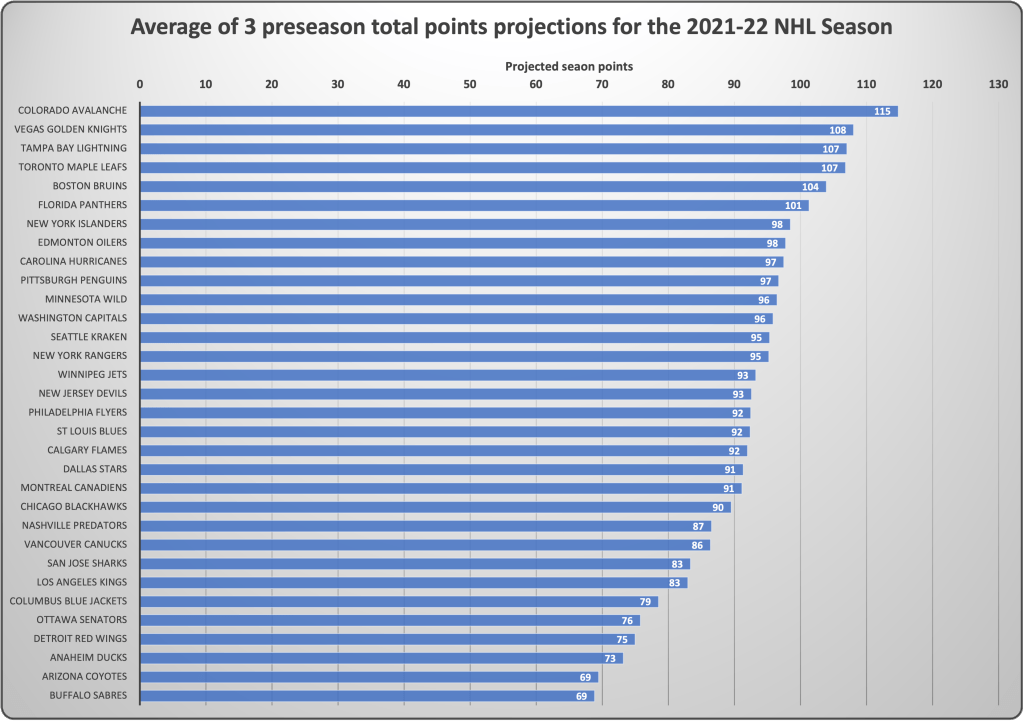
Before this season started, I collected and analyzed three highly ranked total season points projections. They were from Vegas [1], Evolving Hockey [2], and The Athletic [3]. Here are the average of these three projections, all issued during pre-season:

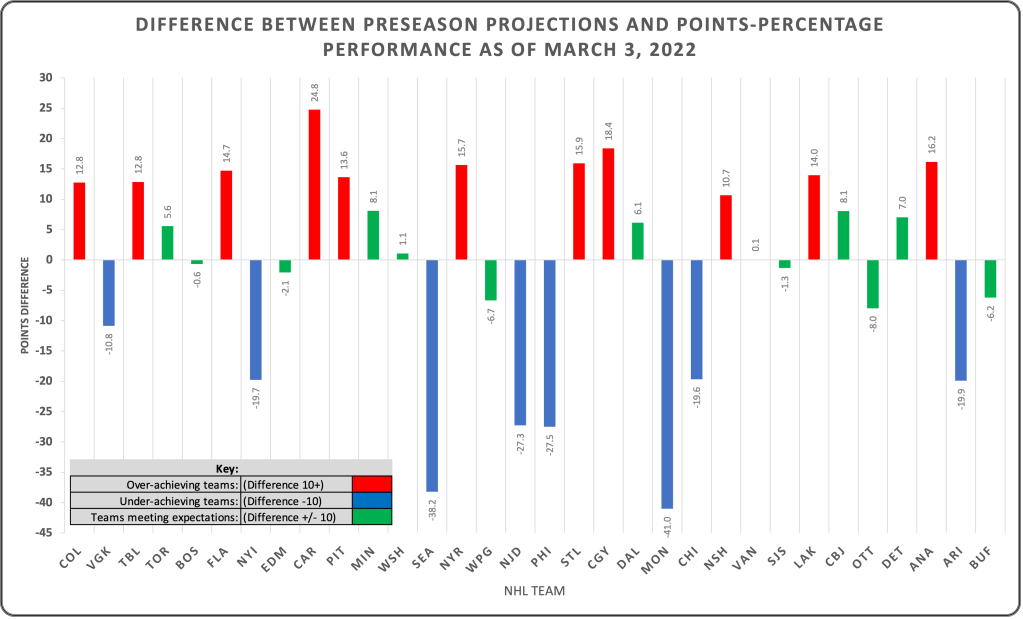
So, now that all teams have played at least 50 games, let’s look at how the teams are doing in terms of points pace compared to these projections. To do that, I made some graphs where I projected point totals for the season based on total team points percentage as of today. I call that season points pace. It’s not perfect in the sense that using points percentage doesn’t give a clean estimate of what will happen in 3 point games. There is some over-prediction of points in this calculation. With that in mind, let’s look at how these preseason projections compare to current points pace:

This graph is ordered by a team’s rank in preseason projections. I think this graph is pretty cool. I applied the rule of thirds and put teams into 3 boxes (over-achieving, under-achieving, and teams on track to meet projections. My decision rule is 10 points above or below). What we end up with is close to the rule of thirds: 11 teams (34%) are over-achieving; 8 teams (25%) are underachieving, and 13 teams (41%) are on track to be within 10 points of preseason projections. The average difference is -0.7 points because, hey, hope springs eternal. The teams that are under-performing are (in many cases) under-achieving in a big way. This list is topped by Seattle (-38) and Montreal (-41). Other notable dissappointments include Vegas (-10), the Islanders (-20), New Jersey (-27), the Flyers (-28), Chicago (-20) and Arizona (-20).

Among over-achieving teams, the biggest surprise may be Carolina, now on pace for a 122 point season. Among the 10 highest rank teams from the pre-season, half are exceeding expectations. Call this regression away from the mean. The Avs are on a blistering pace heading toward greater than 126 total points based on current point percentage. Tampa, Pittsburgh, the Rangers, Blues, Flames, Kings and Ducks are all significantly out-performing predictions.

So, what are the patterns here? What have we learned? This is where the interpretation starts. One obvious thing to say is that Seattle tells us that Vegas was really weird. Expansion teams struggle. The other big pattern I see is that goalie performance is not appropriately taken into account in preseason projections. Most of the over-performing teams are getting better than expected goal tending (think Rangers, Flames, Penguins and Kings). Under-performing goal tenders in Vegas, Montreal, Philadelphia, and Chicago help explain the blue bars. It’s a cheap insight but the gap between preseason projections and team performance seems to be heavily influenced by the one position in hockey that most defies prediction. Preseason projections could improve if we had better models for estimating goaltender performance.

What do you think?

Sources of predictions:
[1] Vegas: https://novacapsfans.com/2021/08/31/vegas-releases-standings-points-projections-for-each-nhl-team-for-the-2021-22-season/
[2] Evolving hockey: https://evolving-hockey.com/blog/2021-2022-nhl-team-point-projections/
[3] The Atlantic: https://novacapsfans.com/2021/08/31/vegas-releases-standings-points-projections-for-each-nhl-team-for-the-2021-22-season/

Which NHL division is the strongest so far?

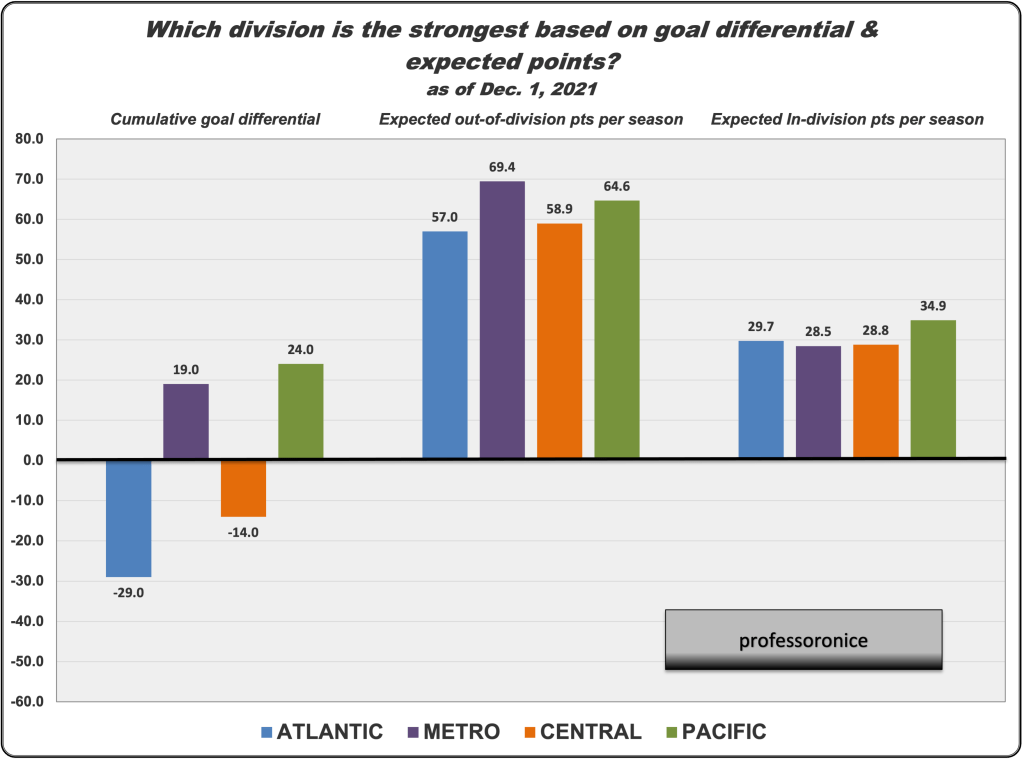
One ongoing interest I have is comparing the strength of the NHL divisions.  Now that we have passed the Thanksgiving break and most teams are at 20 games, it’s time to take a look.  Here is my analysis and it is a surprise.  Have a look at this graph.  There are three different answers to the question of which division is the strongest (overall goal differential, and expected points in and out of the division over an 82 game season based on performance so far). 

Based on all three metrics, the metro and pacific divisions right now are the strongest.  The Atlantic and Central both have negative goal differentials and at least 10 fewer expected out of division points compared to the Metro. I believe the out-of-division points expected is the best overall gauge of a division’s strength. Based on that, I’d give the edge to the Metro right now. Points are hardest to come by in the division (right side) and Metro teams are outpacing the others outside their division. What do you think?

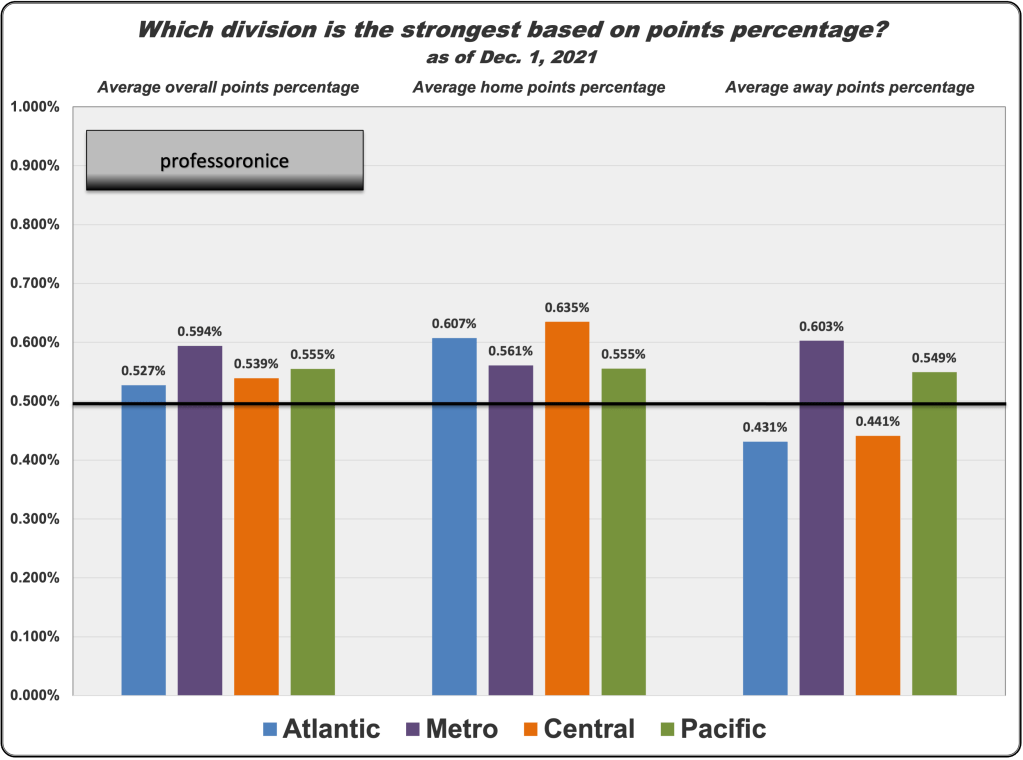
Let’s look at one more graph. This time, it’s average points percentage overall and home vs. away. Points percentage is the percentage of total points that could be won that are, taking account of overtime and shootout losses. Similar story here as the Metro is taking the highest points percentage at 59.4% of available points. More significantly, they are the only division taking over 60% of the points when playing away. There is overall a home-ice advantage in the NHL; except when a Metro team is in your barn. Right now the Metro is the strongest division.

PS: If anyone looked at this page before December 2, you will notice that the figures changed. My original posting contained an error from my spreadsheet that made it appear the Central was the strongest. I apologize for the error.

The biggest mystery in hockey: why have goals gone down since the 80s?

Here is a question for hockey people. There are two massive changes that have impacted hockey over the last 30 years. The first is the shift from wood sticks to more flexible, lighter composite sticks. The Great One set records for points and goals using the old wooden sticks, at least until the arrival of the aluminum shafted stick in the 1990s. Everyone agrees that the new sticks are a big change, both for skaters and goalies. The new composite sticks offer significantly more control, power and precision compared to the old wooden sticks. Second, after the lockout, the NHL introduced Rule 55, ushering in a zero-tolerance policy for hooking, holding and stick violations. The objective of Rule 55 was to unleash the scoring power of the high skill players. Both these changes are hard to underestimate. Both should have increased average scoring in the NHL. Is that what happened?

Have a look at the chart I made today. It’s pretty interesting. It shows the average goals per game for each NHL season from 1980 till today (the blue bars) and the average number of power play goals per game (red bars). The golden age of scoring was in the early 80s. Goals per game peaked at over 4 during the 1981-82 season. That was the heart of the wooden stick/hocking & holding era! Average goals per game stayed above 3.5 until 94-95. The first composite blade wasn’t introduced till 1995. In 2001, the first 1-piece stick was introduced. Scoring fell consistently during the switch from wood to exotic materials. How could that be? After the lockout, rule 55 stimulated a third of a goal per game rise in scoring. Power play goals spiked to over 1 a game in 05-06 only to fall by half a goal a game by 2013. Average goals per game rose from 2.77 to 2.97 in 2017-18 and briefly jumped over 3 a game in 2018-2020.

It is really weird though that composite sticks and the end of hooking and holding resulted in LESS rather than MORE goals. Why is that? I think it’s one of the biggest mysteries of hockey. NHL players have gotten stronger, faster, bigger and more skilled. Their sticks are lighter, more powerful and easier to control. Despite those shifts, average goals per game is about 1 less than it was in the early 80s. There must be something bigger, more potent that is working against the push for higher scoring.

My theory? As the average skating speed of players rises, the effective distance between players shrinks. Faster players on the same size ice means the amount of open ice declines. This, coupled with increased team commitment to defense, means that puck possession and control gets harder. While everyone knows that lighter more powerful sticks improved shooting, they also dramatically improved defense! Lighter sticks help defensemen as much as they do shooters, possibly even more. Faster skaters close the gaps between attackers and defenders, creating less open ice, and forcing more puck chaos.

When are we going to get the speed and possession-level data that will let us study this stuff?