How good are we at predicting what will happen in the NHL? My answer: the experts are not very good. That depends on what you expect. Professional hockey is interesting in part because game play is highly influenced by stochastic factors that defy prediction. My own view is that the most predictable aspect of NHL hockey is the “rule of thirds”: We know at the beginning of the season that approximately a third of teams will perform about as we predict, a third of teams will over-achieve and a third of teams will under-achieve. The problem is that we aren’t good at predicting which teams will end up in which box.
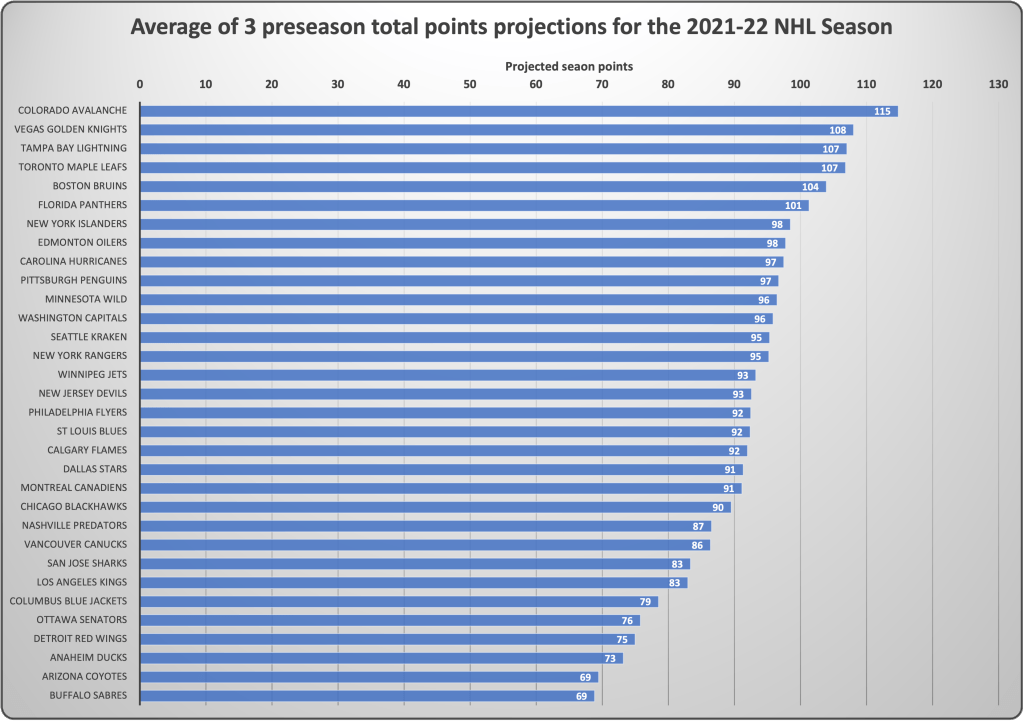
Before this season started, I collected and analyzed three highly ranked total season points projections. They were from Vegas [1], Evolving Hockey [2], and The Athletic [3]. Here are the average of these three projections, all issued during pre-season:
So, now that all teams have played at least 50 games, let’s look at how the teams are doing in terms of points pace compared to these projections. To do that, I made some graphs where I projected point totals for the season based on total team points percentage as of today. I call that season points pace. It’s not perfect in the sense that using points percentage doesn’t give a clean estimate of what will happen in 3 point games. There is some over-prediction of points in this calculation. With that in mind, let’s look at how these preseason projections compare to current points pace:
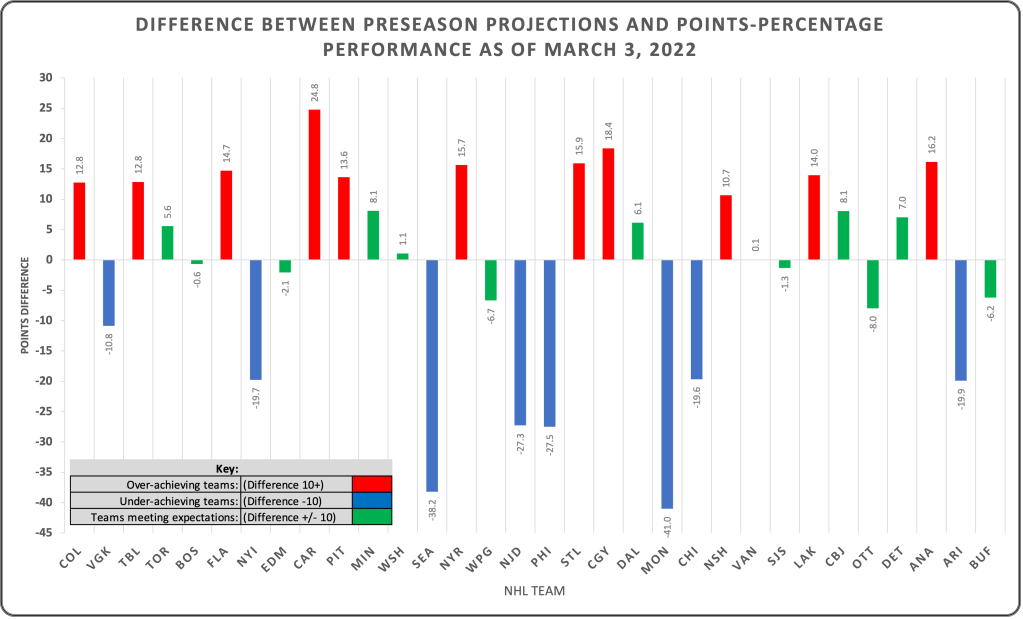
Among over-achieving teams, the biggest surprise may be Carolina, now on pace for a 122 point season. Among the 10 highest rank teams from the pre-season, half are exceeding expectations. Call this regression away from the mean. The Avs are on a blistering pace heading toward greater than 126 total points based on current point percentage. Tampa, Pittsburgh, the Rangers, Blues, Flames, Kings and Ducks are all significantly out-performing predictions.
So, what are the patterns here? What have we learned? This is where the interpretation starts. One obvious thing to say is that Seattle tells us that Vegas was really weird. Expansion teams struggle. The other big pattern I see is that goalie performance is not appropriately taken into account in preseason projections. Most of the over-performing teams are getting better than expected goal tending (think Rangers, Flames, Penguins and Kings). Under-performing goal tenders in Vegas, Montreal, Philadelphia, and Chicago help explain the blue bars. It’s a cheap insight but the gap between preseason projections and team performance seems to be heavily influenced by the one position in hockey that most defies prediction. Preseason projections could improve if we had better models for estimating goaltender performance.
What do you think?
Sources of predictions:
[1] Vegas: https://novacapsfans.com/2021/08/31/vegas-releases-standings-points-projections-for-each-nhl-team-for-the-2021-22-season/
[2] Evolving hockey: https://evolving-hockey.com/blog/2021-2022-nhl-team-point-projections/
[3] The Atlantic: https://novacapsfans.com/2021/08/31/vegas-releases-standings-points-projections-for-each-nhl-team-for-the-2021-22-season/

