Greg Wyshynski (Twitter: @wyshynski) reports that Bill Daley is open to looking at tweaks to the offside video review rules to bring us back to sanity (NHL network radio, 5/29/19). If we can find such a tweak it would allow us to implement in a way that honors the original intent (stop egregious violations resulting in goals) but reduce the hair-splitting.
First, a quick review of the current situation (see www.nhl.com/nhl/en/v3/ext/rules/2017-2018-NHL-rulebook.pdf). Offside violations are governed by rule 83, which looks like this in 2018-2019:
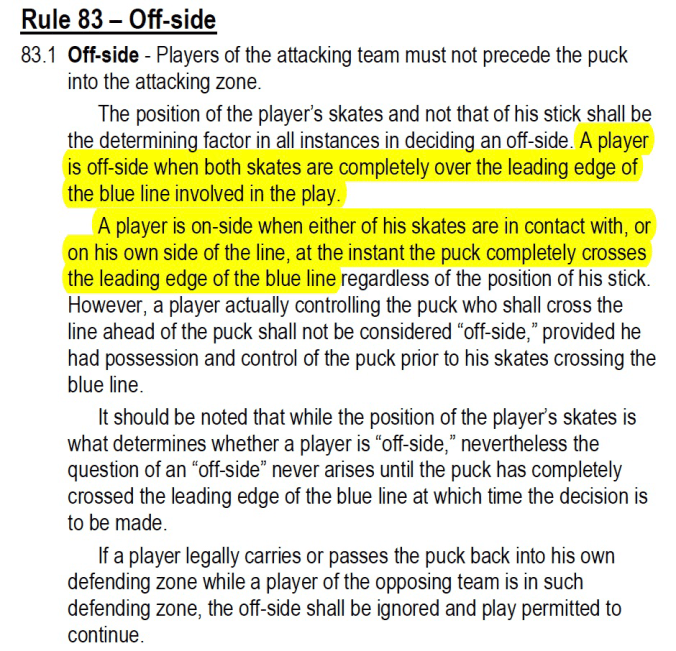
The highlighting is my own. The spirit of the rule invokes a 2-skate principal. Implementation allows for a big loophole: a player with one skate in neutral ice, or part of a skate on or over the line is safe. This rule is challenging for linesmen in-game, but its basically been around in some form since the 1920’s and seems to work OK.
The insanity arises because we insist on keeping the offside rule for in-game action and coach’s challenge and video review the same (see rules 78.6 and 78.7).
Here is a simple idea that might allow us to have our cake and eat it too.
What if there were two separate rules, one governing in-game action, and a separate rule to overturn a good goal call on the ice resulting from a coach’s challenge or league initiated video review?
Here is the idea: Keep the rules governing offside calls exactly the same for in-game action following Rule 83. Its not perfect but we are used to it. Then, create a new rule setting a higher bar to overturn goals on the ice by eliminating the one skate loophole. This new rule would require that the player be completely offside, meaning BOTH skates clearly and evidently in the attaching zone. This change would a) uphold the spirit of the main rule, b) reduce the number of goals disallowed, and c) limit challenges and video review to more egregious violations.
Some will say that this would only shift the micro-analysis to the second skate. I don’t think so. I have reviewed video from dozens of close calls; in the majority of cases, its much easier to determine if both skates are over the line. Because players often intentionally ride or straddle the line when things are close, it makes sense that its easier to see when both skates are offside than to determine if some fancy skate work invokes the loophole. This change would not solve the vertical plane problem (one skate in the air over the line) but anything like that in the gray zone (e.g., partial blade on the line) would be, under this proposal, insufficient to overturn a good goal.
If a player must have both skates in the attacking zone to overturn, we get closer to the spirit of the video review initiative. The only people who might complain are the video coaches whose importance has grown from all this hair-splitting confusion.
 Professor on Ice